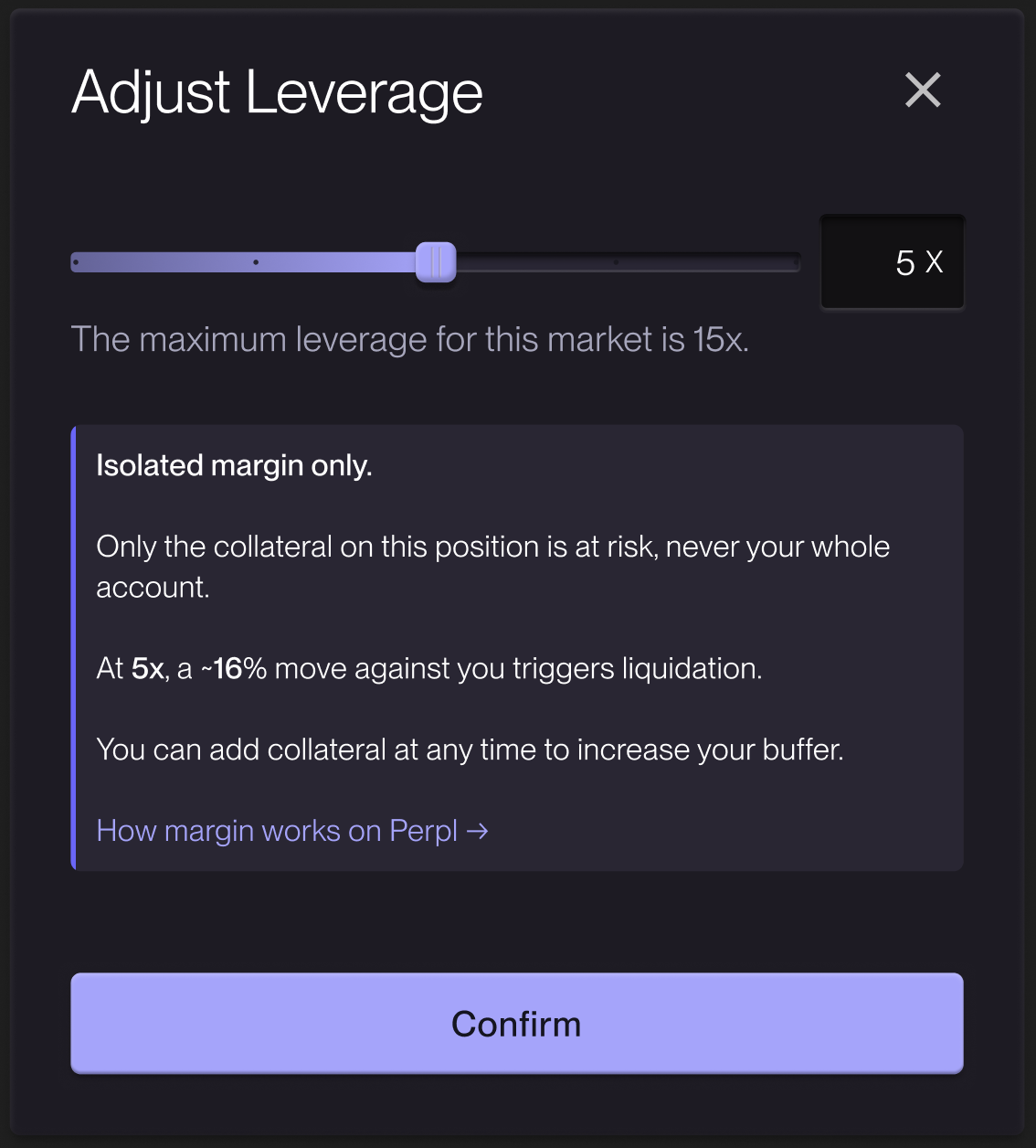
(20% − 5%) ÷ (1 − 5%) ≈ 16%
Lower leverage widens this distance; higher leverage narrows it. Maintenance margin varies by market, so the exact figure for your position is shown live in the Adjust Leverage dialog. You can add collateral to an open position at any time to increase it.
N = P · L
*P = The mark, entry, or realized price, depending on whether or not the value being calculated is unrealized, position, or realized notional value, respectively.*\ *L = The position lot size (the number of contracts of the position).* **Position Margin Requirement, *****MR*****:**MR = N/MF
*N = The position notional value.*\ *MF = The margin fraction (analogous to leverage).* **Position Initial Margin Requirement, *****IMR*****:**IMR = N/IMF
*N = The position notional value.*\ *IMF = Initial margin fraction (maximum leverage allowed to open a position).* **Position Maintenance Margin Requirement, *****MMR*****:**MMR = N/MMF
*N = The position notional value.*\ *MMF = Maintenance margin fraction (minimum collateralization permitted before a position can be*\ *liquidated).* #### Collateral Management **Increase Collateral** Traders can add margin to an existing position at any time to reduce the risk of liquidation. This increases the position's `depositCNS` without affecting the entry price or lot size. **Decrease Collateral (DCP)** Traders can remove excess margin from a position, subject to the following constraints: * **120-second expiry**: A DCP request must be executed within 120 seconds of submission. After this window, the request expires and must be resubmitted. * **Margin tolerance check**: The remaining collateral after the decrease must still satisfy the initial margin requirement for the position. * **OI threshold**: DCP is blocked when the perpetual's open interest exceeds the `dcpBorrowThreshHdths` threshold (default 85% of capacity), as the market is under stress. {% hint style="info" %} The 120-second expiry on DCP prevents stale withdrawal requests from being executed after market conditions have changed significantly. {% endhint %} #### Margining Criteria The price used to determine the notional value in the invariants presented in this section is the most accurate price available. For example, the best price to use for the notional value of a new position is the price at which the position is entered (realized). In some situations, for example, auto-deleveraging a position, a realization price is not available, and the failed position's bankruptcy price is used. In other situations, the mark or synthetic perpetual price may be used to calculate the position's fair market value (for the value of an existing position). **Collateralization for establishing or changing a position:**FMV >= IMR
*FMV = Position fair market value.*\ *IMR = Position initial margin requirement.* {% hint style="info" %} **Reduce-only exemption**: Closing or decreasing a position does not require FMV >= IMR. This allows traders to close underwater positions that would otherwise be trapped. {% endhint %} **Collateralization for liquidation:**0 < FMV <= MMR
*FMV = Position fair market value.*\ *MMR = Position Maintenance margin requirement.* **Collateralization for Auto Deleverage (ADL):**FMV <= 0
*FMV = Position fair market value.*